
Though the equation is a result of multiple scientific breakthroughs and discoveries, Albert Einstein is largely credited for it, as he brought these contributions together.
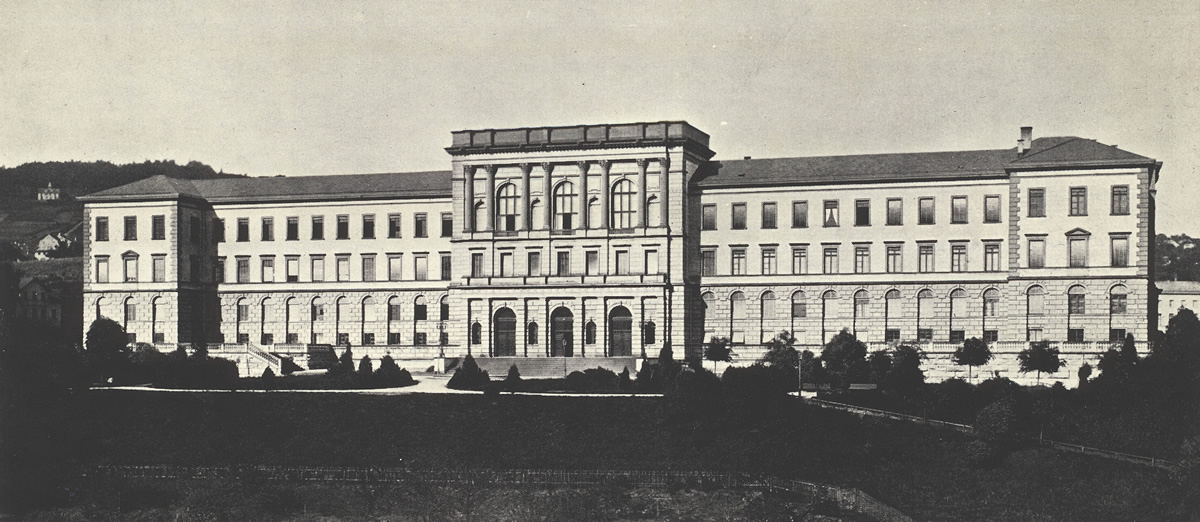
ETH Zurich, 1890. The college Einstein attended. Courtesy of
ETH Zurich
"The only thing that interferes with my learning is my education."
~ Albert Einstein
Einstein had a rough start...
He was a slow learner, was rebellious towards studies, and became a school dropout. He was also continuously called hopeless by his teachers...
"[To Einstein] Lazy Dog"
~ Herman Minkowski, Einstein's math professors
"Nothing would ever become of you"
~ Joseph Degenhart, Einstein's high school Greek grammar teacher
He had a difficult time when it came to jobs and money...
"He had applied for a promotion from patent clerk third class to patent clerk seconds class. His supervisor, Dr Haller, had rejected him, writing in an assessment that although Einstein had 'displayed some quite good achievements,' he would still have to wait 'until he has become fully familiar with mechanical engineering.'...
Einstein was 26. He couldn't even afford the money for part-time help to let his wife go back to her studies."
~ David Bodanis, author of 'A Biography of the World's most famous equation'
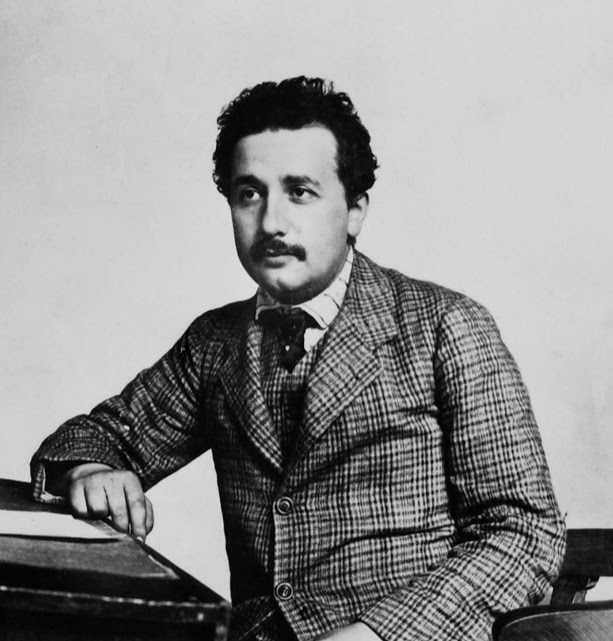
Einstein in his Patent Office, 1905, Courtesy of Wikipedia Commons.
He kept on pursuing his passion in science despite this.
"Nothing, indeed, could turn him[Einstein] away from the sole aim of his being, in the service of which was accumulated all the immortal fire within his nature, all that was great and vital in his spirit."
~ Max Brod, Journalist in the 20th century
Einstein was a visual learner, so he performs thought experiments often. He visualizes scenarios to simulate ideas and scientific principles. These experiments are what lead him into making his famous discoveries.
A demonstration of one of Einstein's many thought experiments, part of the development of his Theory of Relativity, Courtesy of PBS NOVA
It didn't take long until Einstein made a thought experiment that directly lead to the formation of E=mc².
"It was based on yet another thought experiment. Imagine an object that's sitting at rest, he said. And now imagine that it spontaneously emits two identical pulses of light in opposite directions. The object will stay put, but because each pulse carries off a certain amount of energy, the object’s energy content will decrease.
Now, said Einstein, what would this process look like to a moving observer? From her perspective, the object would just keep moving in a straight line while the two pulses flew off. But even though the two pulses’ speed would still be the same--the speed of light--their energies would be different: The pulse moving forward along the direction of motion would now have a higher energy than the one moving backward.
With a little more algebra, Einstein showed that for all this to be consistent, the object not only had to lose energy when the light pulses departed, it had to lose a bit of mass, as well. Or, to put it another way, mass and energy are interchangable."
~ Mitch Waldrop, PhD Physicist
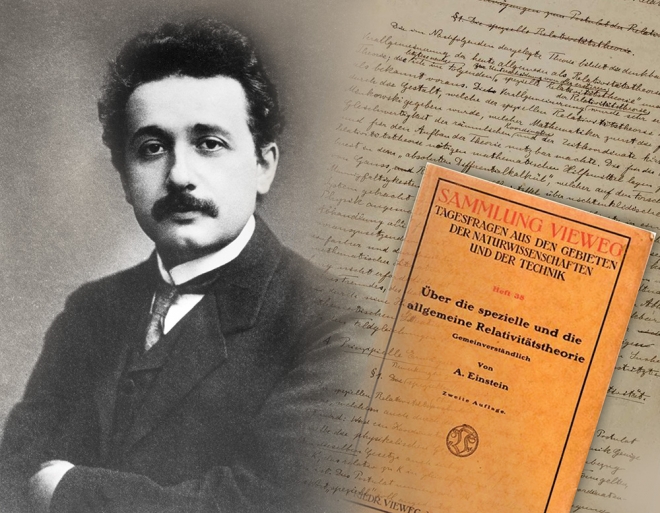
Albert Einstein and his papers on the theory of relativity, 1905. Courtesy of American Institutes of Physics
Einstein wrote about mass-energy equivalence (E=mc²) as one of the four papers he published during his Annus mirabilis, or miracle year. His papers and equation weren't popular at first, as most other physicists struggled to understand the new concept. Max Planck, a famous scientist, encouraged scientists to take Einstein more seriously though. After about 4 years of Einstein's paper publications, people finally understood the incredible significance of Einstein's equation.
"[Referring to Einstein] No other man contributed so much to the vast expansion of 20th century knowledge. Yet no other man was more modest in the possession of the power that is knowledge, more sure that power without wisdom is deadly."
~ Dwight D Eisenhower, former US president, shortly after Einstein's death