
"Science is a human endeavor that builds on the contributions and efforts of many people. "
~David Kaiser, an associate professor in the MIT Program in Science, Technology, and Society
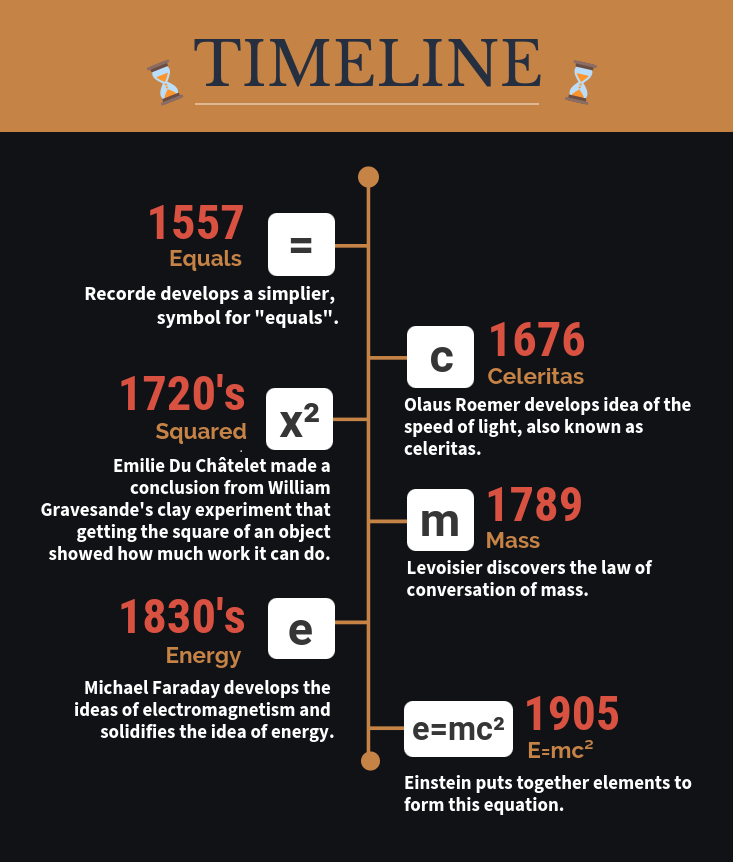
Timeline made by Chelsea Ongjoco using Venngage
Like many other scientific discoveries, the equation E=mc² was built on scientific works that came before it.
Every work came with its own share of barriers and challenges. Some of the contributors cited on the diagram on the left were not spared from this.
For Recorde and Roemer, their contributions were made at the beginning of the scientific revolution. Since this was the early stage of that era, society was not yet keen on accepting new concepts, and thus made being a scientist much harder.
Émilie Du Châtelet and Leviosier's wife, contributed greatly to science, despite the discrimination against women they faced during their time period.
Faraday was young and uneducated, and many didn't respect him, but he proved that the youth can be capable and are worthy of respect.
These breakthroughs proved that the people in discriminated groups are capable as well, and their actions serve as an indirect contribution to the battle for equality.
Marie Curie
"I have frequently been questioned, especially by women, of how I could reconcile family life with a scientific career. Well, it has not been easy."
~ Marie Curie, a female scientist and two time Nobel Prize Winner
Marie Curie investigated the phenomenon of large amounts of energy spewing out of certain elements over a long period of time without losing measurable mass. She faced many obstacles along the way though.
"A Great Scientist... a women who stands out as one of the greatest scientist of all time. She was none other than Marie Curie...
In 1891 she was exiled from Poland on account of her patriotic activites... a garret room was all she could afford, and her meals were only bread and chocolate. She matriculated at the Sorbonne and washed dishes and took care of furnaces to meet expenses...
~ Article in Marion Progress newspaper, 1936
Because of her perseverance, she got recognized by Becqueril.
Becqueril [another scientist] had watched Marie Curie in her laboratory, had recognized her as trained and gifted experimenter. He presented the problem to her. She induced her husband to join her in dropping their work, to join the great adventure of tracking down the powerful, unknown element in uranium."
~ Article in Marion Progress newspaper, 1936
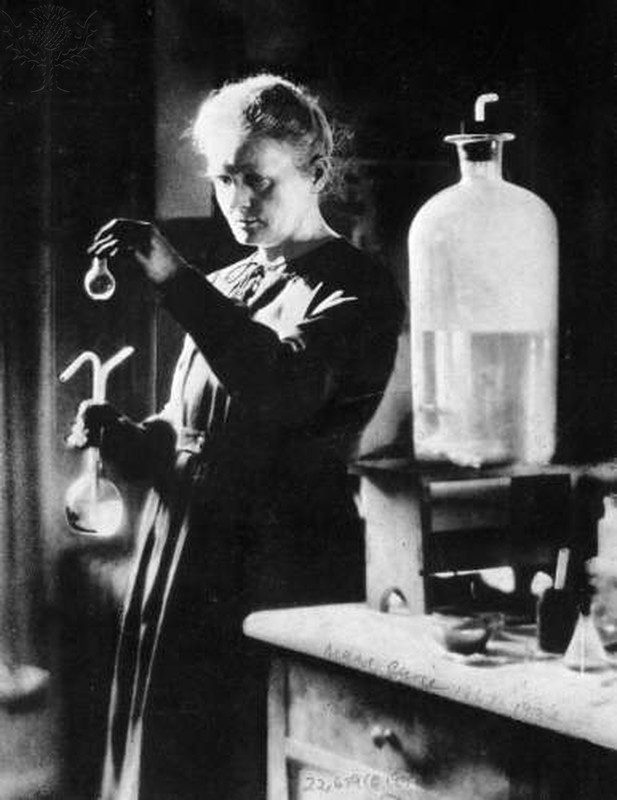
Marie Curie, (1867-1934), Courtesy of Britannica
She researched an unknown property of Uranium which later became known as radioactivity. The discoveries she made regarding radioactivity were essential for further scientific development, and later backed up Einstein's equation.
With this, she received Nobel prizes in Chemistry and Physics. The acknowledgment Curie received for her scientific work marked another breakthrough, helping pave the way for women in science.
"It is my earnest desire that some of you should carry on this scientific work and keep for your ambition the determination to make a permanent contribution to science."
~ Marie Curie