With the emergence of high-energy particle physics, the 1920s and 1930s became the golden age of nuclear research.

"Perhaps the equation's most far-reaching legacy is that it provides the key to understanding the most basic natural processes of the universe, from microscopic radioactivity to the big bang itself."
~ Peter Tyson, Editor in Chief of PBS NOVA
Nuclear Fission
"Our entire understanding of nuclear processes would be sort of lost without it[e=mc²]"
~ Arlin Crotts, a professor of astronomy at Columbia University
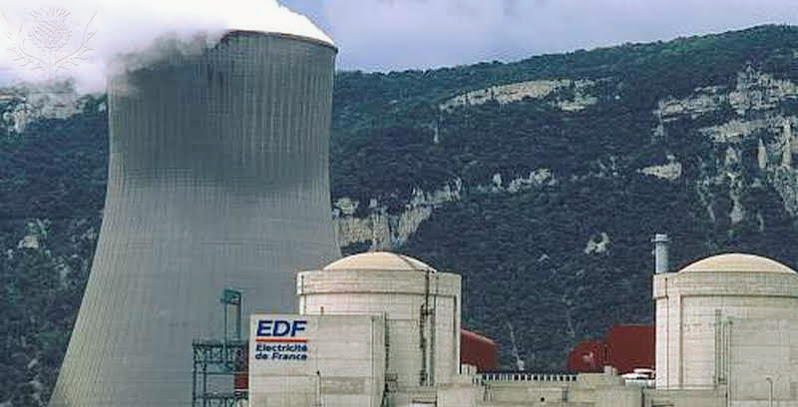
A modern nuclear power plant. Because of the discovery of nuclear fission, people were able to produce energy using the powerful energy of the atom. Courtesy of Britannica
Nuclear fission is when the nucleus of an atom splits into smaller nuclei, and results in the release of energy. This is essentially E=mc² in action, as mass is being converted to energy.
This shattered the boundaries of possibilities when it came to energy sources, and gave rise to nuclear energy.
Lise Meitner was the main contributor in discovering nuclear fission. She had many barriers of her own while doing so...
"As a young woman she [Lise Meitner] went to Berlin [in 1907] without the slightest prospects for a future in physics [German Universities don't employ female graduates]... [but she found] a mentor and friend in Max Planck and a collaborator [lab partner] in Otto Hahn, a chemist just her age..."
~ Ruth Lewin Sime, American author in 20th century
She had to work in a lousy shack while other men like Otto Hahn worked in labs. She faced many other challenges as well, like limiting scientific research for WW1, and being betrayed by Hahn by getting forced out of work.
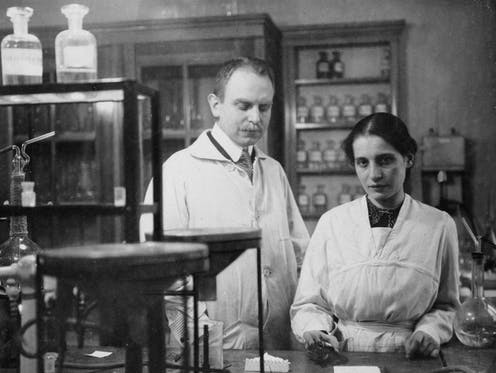
Lise Meitner (right) and Otto Hahn (left), Courtesy of The Conversation US.
"...In the 1920s Meitner went on, independent of Hahn, into nuclear physics, an emerging field in which she was a pioneer… and although at times she was haunted by the insecurity... she never doubted that physics was worth it."
~ Ruth Lewin Sime, American author in 20th century
Eventually Hahn experienced a long, 10-year deadlock in his progress of splitting an atom, and needed her back to break it.
"She[Meitner] was a much better analyst and theoretician than Hahn…"
~ David Bodanis, author of a book on e=mc²
After coming to help, she accomplished the extraordinary feat of splitting the atom, nuclear fission.
"Later Dr Meitner made mathematical equations for what should take place in the division of an uranium atom. Two weeks later physicists tried an experiment which proved her calculation correct, broke the deadlock in atomic fission experiments and led to the eventual development of the atomic bomb."
~ The Sunday Star, newspaper, 1945
Sadly...
"Hahn took her groundbreaking insight and ran with it, publishing the discovery without mentioning her name... Meitner felt deeply betrayed by the injustice... In 1944, the discovery of nuclear fission was awarded the Nobel Prize in Chemistry — to Hahn alone."
~ Maria Popova, writer of literary and arts commentary and cultural criticism
"Hahn has just published absolutely wonderful things based on our work together … much as these results make me happy for Hahn, both personally and scientifically, many people here must think I contributed absolutely nothing to it — and now I am so discouraged."
~ Lise Meitner, writing to her brother about Hahn's betrayal.
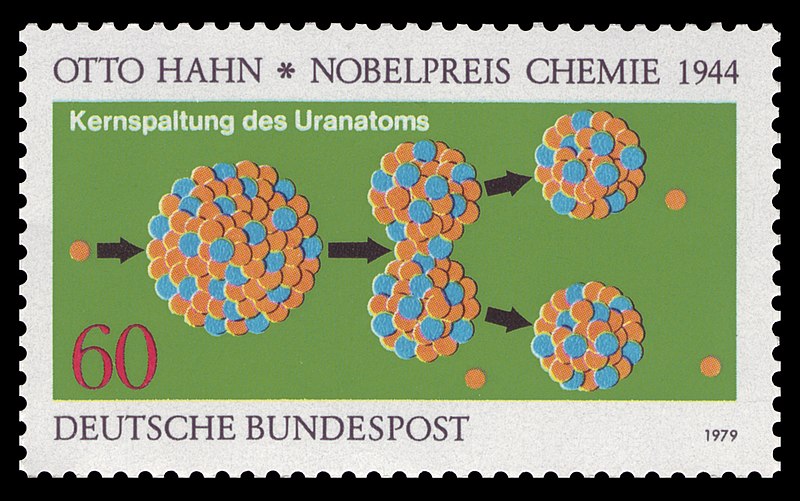
One stamp in the stamp series for nobel prize winners of physics and chemistry, the one crediting Otto Hahn with the discovery of nuclear fission, Germany 1979. Courtesy of Wikipedia Commons.
Even if she didn't get properly credited in her lifetime, she still contributed to the fight against discrimination from her displays of perseverance. She set an example to be ambitious and work hard despite the obstacles that may come their way. Also thanks to her perseverance, people are able to utilize nuclear fission for more revolutionary developments.
The Atomic Bomb
Albert Einstein himself was directly related to the formation of the Atomic bomb. He wrote a letter to President Roosevelt to suggest taking action to form their (the US's) own atomic bomb.
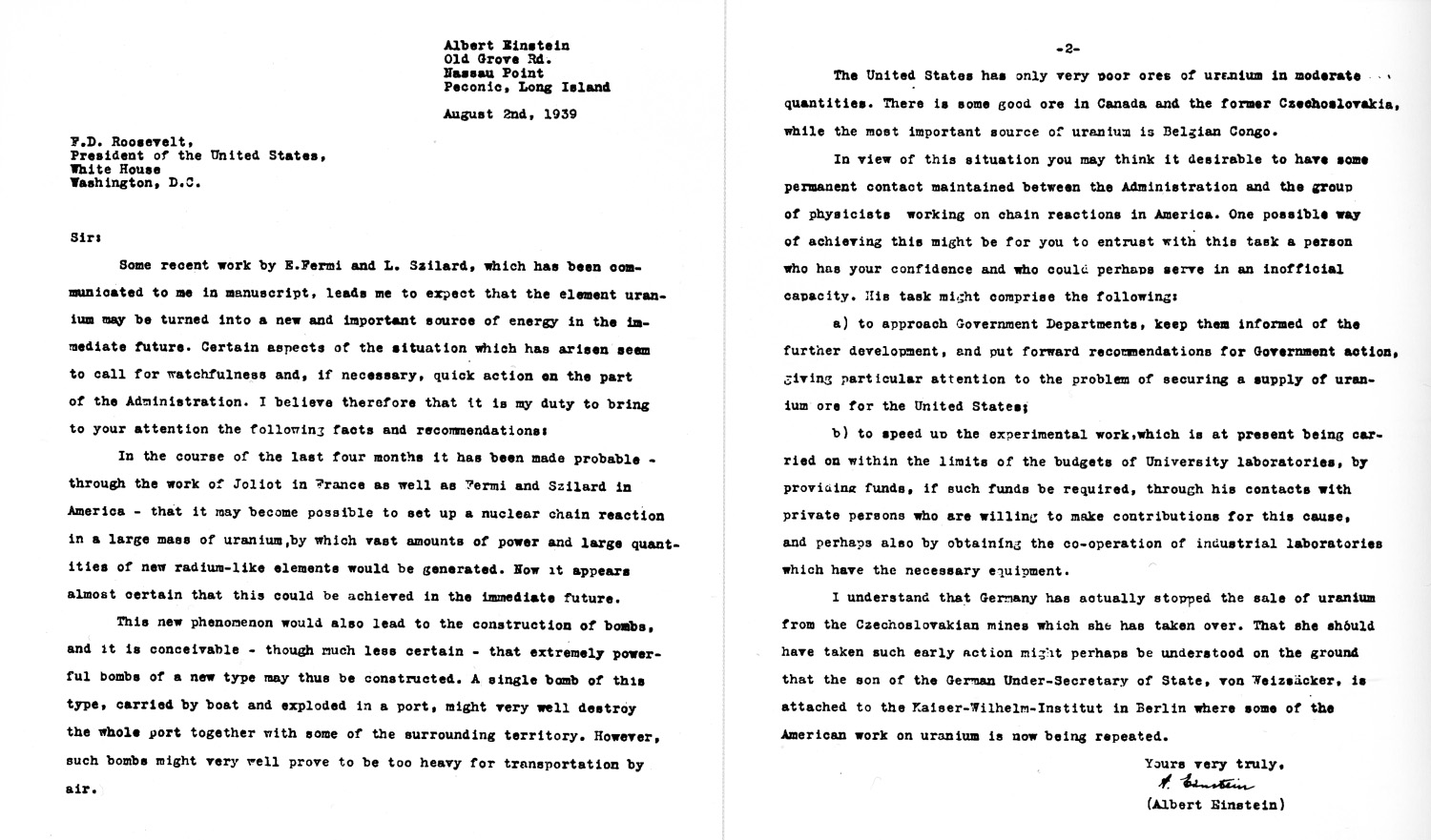
Einstein-Szilard Letter, Eintein's letter to the President Roosevelt to begin formation of US atomic bomb, 1939, Courtesy of Atomic Heritage Foundation
Excerpts from Einstein's letter above...
"...It may become possible to set up a nuclear chain reaction in a large mass of uranium, by which vast amounts of power and large quantities of new radium-like elements would be generated. Now it appears almost certain that this could be achieved in the immediate future.
This new phenomenon would also lead to the contruction of bombs, and it is conceivable...that extremely powerful bombs of a new type be contructed. A single bomb of this type, carried by best and exploded in a port, might very well destroy the whole port together with some surrounding territory...
In view of this situation you may think it [be] desirable to have some permanent contact maintained between the Administration and the group of physicists working on chain reactions in America...
[Reccomendation of courses of actions for the President...]
a) to approach Government Departments, keep them informed of the further development, and put forward recommendations for Government actions, giving particular attention to the problem of securing a supply of uranium ore for the United States.
b)To speed up the experimental work, which is at present being carried on within te limits of the budgets of University laboritories, by and perhaps also by obtaining the co-operation of Industrial laboritories which have the necessary equipment.
~ Albert Einstein in the Einstein-Szilard Letter, 1939
The deeper understanding of physics from E=mc², allowed scientists of WW2 to utilize nuclear energy to produce a bomb. The US called for this new nuclear atom bomb to drop on Hiroshima and Nagasaki in Japan.
"...President's truman's statement that it packs the wallop of 20,000 tons of TNT--the most powerful explosive until harnessing the power of atomic energy"
~ The Evening Star, Aug 7, 1945, the day after the first atomic bombing
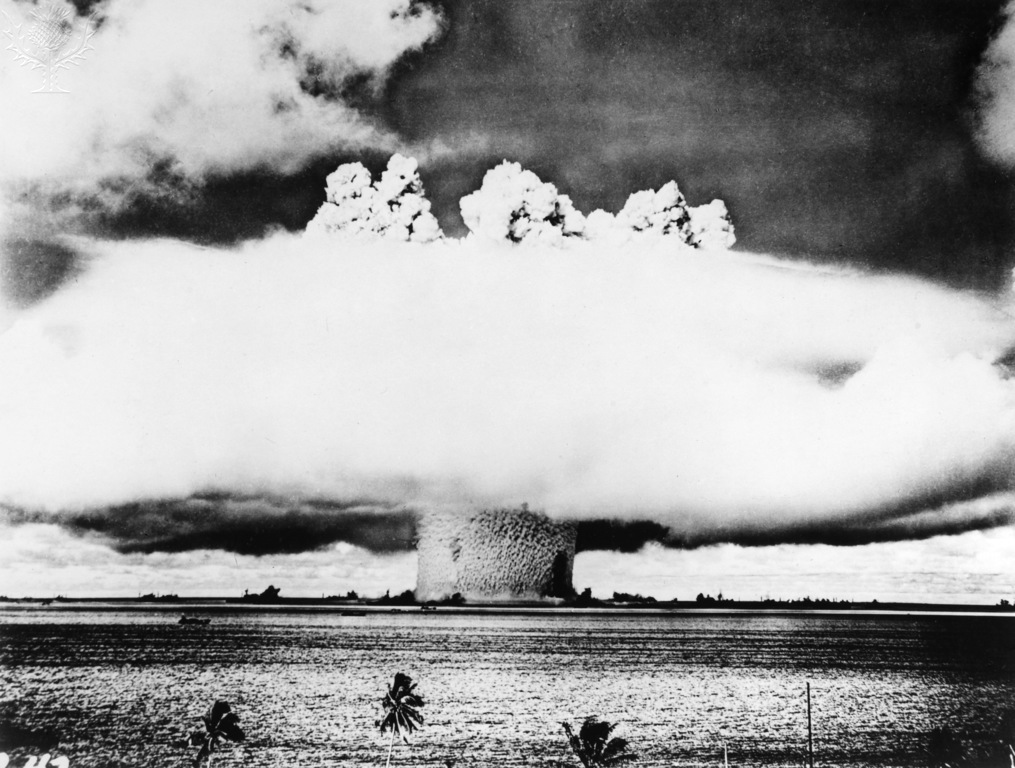
Atomic Bomb Test in the Pacific Ocean, 1947, Courtesy of Britannica Image Quest
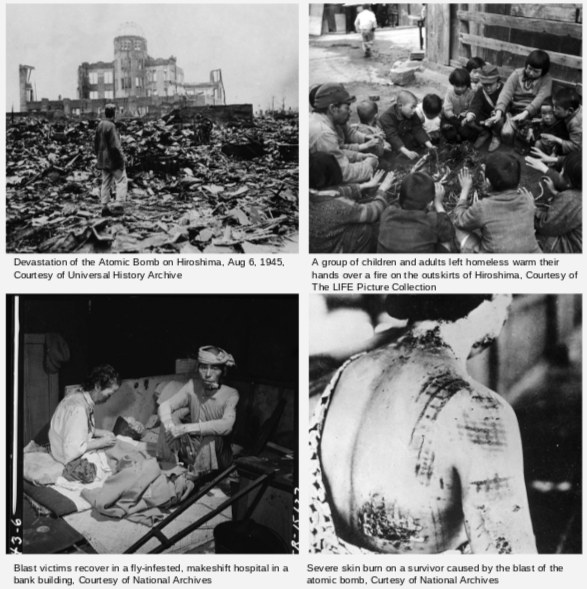
Calling the Atomic Bomb destructive would be an understatement. Though the devastation was tragic, the detonation of the bombs was a crucial step to making the Japanese surrender and end WW2.
"As a result of this wanton attack a considerable number of houses in the city were demolished while fires were caused to start at several points"
~ Text of a broadcast by the Associated Press, Published by The Evening Star, the day after the first atomic bombing
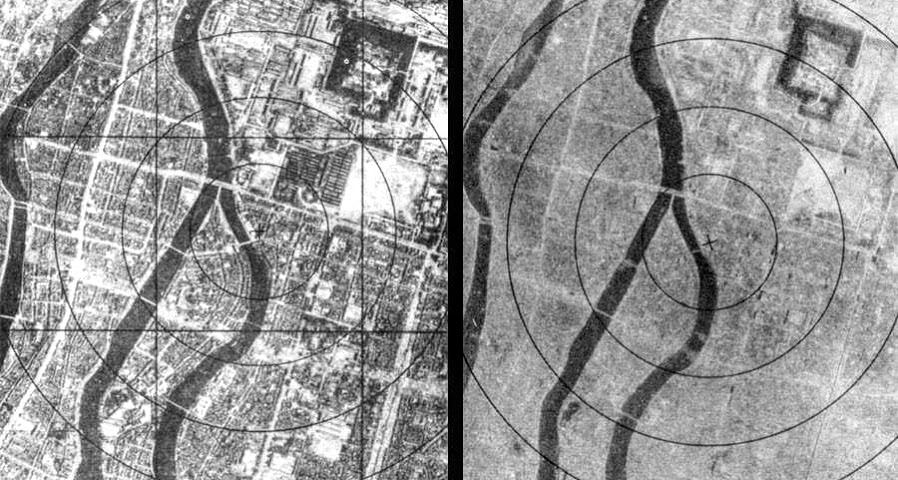
Before and After Aerial Images Hiroshima Bombing, Courtesy of US Department of Defense.